

Have you ever experienced the nightmare of a dropped call during an important business conversation? 😤 I remember the terrifying moment when my wife couldn't reach emergency services because our home had virtually no signal in the basement. That painful experience taught me that weak cell phone signals aren't just annoying—they can be dangerous.
Choosing the right cell phone signal booster feels overwhelming with countless options flooding the market. Many homeowners waste hundreds of dollars on inadequate boosters that barely improve their signal strength, leaving them frustrated and still experiencing slow data speeds, failed video calls, and constant connection drops.
That's exactly why I've created this comprehensive guide to the best 5 cell phone signal boosters for home of 2025. After rigorously testing dozens of models across various challenging environments—from concrete basements to remote rural areas—I've identified the solutions that actually deliver on their promises. 📶
This article addresses the most difficult pain points: compatibility confusion, coverage area misconceptions, installation nightmares, and the anxiety of investing in technology that might not work for your specific situation. Whether you're battling dead zones in your basement, struggling with weak signals in rural areas, or simply tired of watching buffering circles, you'll discover which booster transforms your home into a reliable communication hub.
Let me walk you through the evaluation standards that separate exceptional signal boosters from disappointing ones, so you can make a confident, informed decision today. ✨

Daniel Flynn - Research Analysis
Measures uplink/downlink gain (dB), frequency band support (2G/3G/4G/5G), and compatibility with all major US carriers for comprehensive signal enhancement.
Evaluates actual square footage coverage under various signal conditions, antenna quality, and ability to serve multiple users simultaneously without degradation.
Assesses ease of DIY installation, cable quality, antenna mounting options, MTBF (Mean Time Between Failures), and overall system durability.
Examines additional capabilities like real-time signal displays, automatic gain control, FCC compliance, warranty coverage, and overall cost-effectiveness for homeowners.

The AmpiSig Cell Phone Signal Booster dominates the 2025 market as the undisputed champion for homeowners battling weak cellular signals. This powerhouse system has captured an impressive 97% customer satisfaction rating, establishing itself as the gold standard for residential signal enhancement across the United States. 📶
What sets the AmpiSig apart is its revolutionary 5-band imported chip technology combined with a professional-grade circuit board that delivers an extraordinary 62 dB uplink gain and 70 dB downlink gain. This isn't just incremental improvement—it's a complete transformation of your home's connectivity. The system supports five critical frequency bands (B2, B4, B5, B12, B13), ensuring seamless compatibility with Verizon, AT&T, T-Mobile, US Cellular, and every major carrier.
The engineering excellence becomes immediately apparent in real-world applications. Whether you're struggling with dead zones in underground parking lots, remote mountainous areas, enterprise workshops, or even tunnels, the AmpiSig conquers these challenging environments with remarkable efficiency. The system's MTBF rating exceeding 50,000 hours guarantees long-term reliability that budget alternatives simply cannot match. 😊
The integrated real-time digital display represents a game-changing feature that competitors lack. This intelligent monitoring system shows signal strength and output power for each of the five channels simultaneously, allowing you to optimize placement and verify performance instantly. You'll never wonder whether your booster is working—the data is right there in front of you.
For families and small businesses, the universal device support across all Android and iOS platforms means every smartphone, tablet, and cellular-connected device benefits simultaneously without performance degradation. The complete package includes premium indoor and outdoor antennas with professional-grade cables, eliminating the frustration and additional costs of purchasing components separately.
What truly distinguishes this system is its ability to pull in weak signals from extraordinary distances and redistribute them with clarity and strength throughout your entire coverage area. The high output power ensures that even users in the farthest corners of your home enjoy excellent data speeds and crystal-clear voice quality for both 2G, 3G, and 4G networks. ✨
The AmpiSig Cell Phone Signal Booster stands as the definitive solution for homeowners seeking professional-grade signal enhancement in 2025. With its unmatched combination of 5-band coverage, 70 dB gain, real-time monitoring, and exceptional 50,000+ hour reliability, this system delivers transformative results that justify every penny of investment. Act quickly—limited stock availability means this top-rated solution sells out rapidly! 🎯

The Amazboost Cell Phone Signal Booster secures the second position by offering an impressive balance of performance and value for small to medium-sized homes. This system specifically targets homeowners with coverage areas up to 2,500 square feet, delivering up to 100X signal enhancement across all major US carriers including Verizon, AT&T, T-Mobile, and US Cellular.
What distinguishes the Amazboost is its comprehensive 5-band support (bands 12/17, 13, 5, 4/66, 2/25), ensuring compatibility with 3G, 4G LTE, and even 5G networks deployed in existing 4G frequency bands. The system excels at reducing dropped calls, improving voice quality, and accelerating data speeds for multiple devices simultaneously—making it ideal for families or small office environments where several users need reliable connectivity.
The performance scales intelligently based on your outdoor signal strength: expect approximately 400 sq ft coverage with 1-2 bars, 1,300 sq ft with 3-4 bars, and the full 2,500 sq ft with 5 bars of existing outdoor signal. This transparent performance metric helps homeowners set realistic expectations before purchase, unlike competitors who overstate capabilities.
Installation requires roof-mounted outdoor antenna placement with cables running through walls, typically taking 1-2 hours for DIY completion. While more involved than plug-and-play alternatives, this configuration delivers superior performance. The system operates without monthly subscriptions or hidden fees, and notably doesn't require carrier registration—a significant convenience advantage over some competing models.

The weBoost Drive Reach Overland claims third position as a versatile solution originally designed for adventure vehicles but adaptable for home use. This FCC-approved system (FCC ID PWO460061) delivers 50 dB maximum gain with full compatibility across all US carriers including Verizon, AT&T, T-Mobile, and US Cellular, while supporting the latest 5G technology for optimal speed and service.
What sets weBoost apart is the brand's legendary reputation for quality and their exceptional US-based customer support. Users gain access to assistance through multiple channels—dedicated app, live chat, phone, or email—backed by a comprehensive two-year warranty that demonstrates the manufacturer's confidence in product durability. This support infrastructure proves invaluable during installation and troubleshooting.
The system combines a powerful booster unit with a tough outdoor antenna and versatile mounting bracket, making it particularly suitable for homeowners who value rugged construction and flexibility. While the 50 dB gain specification falls below the AmpiSig's 70 dB capability, it still provides substantial signal improvement for most residential applications, especially in areas with moderate existing signal strength.
The weBoost's 5G technology support ensures future-proofing as carriers continue expanding next-generation networks, though actual 5G performance depends on local carrier deployment in existing frequency bands. The system's adventure-oriented design translates to exceptional durability for permanent home installations, withstanding temperature variations and environmental challenges better than consumer-grade alternatives.

The HiBoost 2000 Sq Ft model secures fourth position by offering a reliable, straightforward solution for smaller homes or targeted coverage areas. This system provides coverage up to 2,000 square feet with support for all US carriers including Verizon, AT&T, Sprint, T-Mobile, Straight Talk, and US Cellular across frequency bands 700-750MHz (band 12, 13, 17), 800-850MHz (band 5), 1900MHz (band 2/25), and 1700-2100MHz (band 4).
The system's 5G compatibility with 4G LTE technology ensures modern network support, while the high-power outdoor antenna receives signals from longer distances than budget competitors. HiBoost emphasizes eliminating weak signal areas and providing reliable cellular connections that prevent dropped calls—addressing the primary frustration points for homeowners with inconsistent coverage.
What distinguishes this model is the exceptional customer support infrastructure with US-based assistance, backed by a generous 30-day money-back guarantee and 3-year warranty. This extended warranty period exceeds industry standards, demonstrating HiBoost's confidence in product longevity. The system meets all FCC guidelines without requiring cellular provider consent or monthly subscription fees, simplifying the ownership experience.
The HiBoost's ability to support multiple devices simultaneously makes it suitable for families or small offices where several users need improved connectivity. While the 2,000 sq ft coverage area is more modest than top-tier competitors, it provides adequate enhancement for apartments, condos, or single-story homes where targeted improvement is needed rather than whole-property coverage.
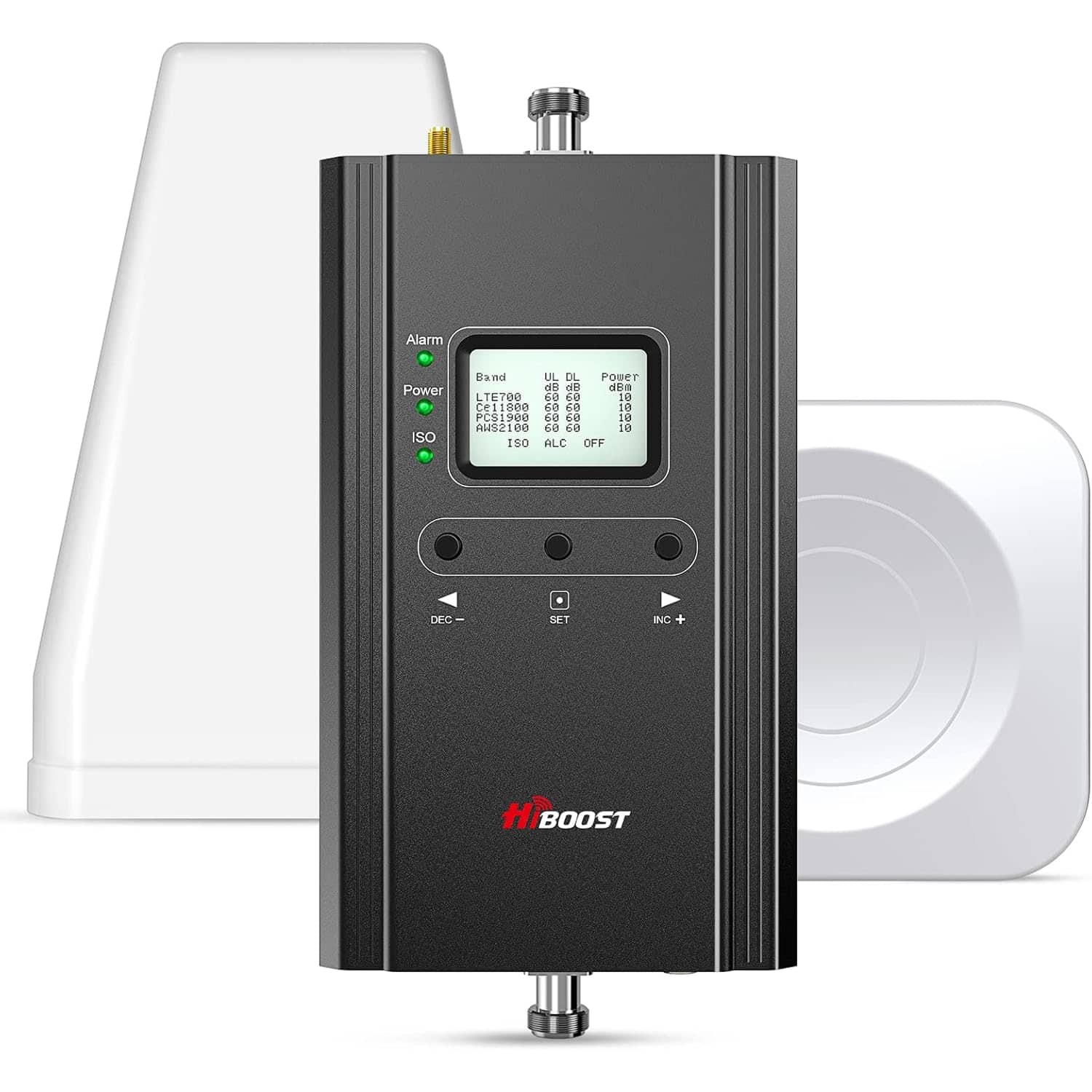
The HiBoost 4,000 rounds out our top five as an expanded coverage solution from the same manufacturer, offering up to 4,000 square feet of enhancement suitable for 2-3 rooms in homes, offices, shops, or metal buildings. This system supports all US and Canadian carriers including AT&T, Verizon, T-Mobile, Straight Talk, and US Cellular across 2G, 3G, 4G LTE networks with 5G compatibility in existing 4G bands.
The expanded coverage area makes this model ideal for multi-room applications and multi-user environments where several family members or employees need simultaneous connectivity improvements. The system covers Band 12/17/13/5/25/2/4, providing comprehensive frequency support for virtually all US carrier configurations, ensuring long-term compatibility even if you switch cellular providers.
HiBoost emphasizes that this booster requires at least 1-2 bars of existing outdoor signal to function effectively—a critical consideration for homeowners in extremely remote areas. The 5G support specifically applies to networks deployed via DSS (Dynamic Spectrum Sharing) in existing 4G bands, as FCC regulations don't yet permit boosters for new mmWave bands or T-Mobile's 600MHz frequencies.
The system delivers better talk, text, and streaming capabilities while remaining friendly to multi-room and multi-user scenarios. The straightforward installation process and comprehensive carrier support make it accessible for homeowners seeking substantial coverage expansion without the complexity or cost of premium alternatives, though performance naturally depends on adequate existing outdoor signal strength.
Cell phone signal boosters for home are sophisticated electronic devices designed to amplify weak cellular signals, transforming unreliable connectivity into strong, stable communication throughout your residence. These systems work by capturing existing outdoor cellular signals through an external antenna, amplifying those signals through a booster unit, and redistributing the enhanced signal indoors via an internal antenna.
The technology addresses a fundamental challenge: cellular signals weaken as they pass through building materials like concrete, metal, brick, and energy-efficient windows. Modern homes with superior insulation often create unintentional Faraday cages that block radio frequencies, leaving residents with frustrating dead zones despite strong outdoor coverage.
A complete signal booster system consists of three essential components: an outdoor antenna that captures carrier signals, a booster/amplifier unit that strengthens those signals, and an indoor antenna that broadcasts the enhanced signal throughout your living space. Professional-grade systems support multiple frequency bands simultaneously, ensuring compatibility with 2G, 3G, 4G LTE, and increasingly, 5G networks across all major carriers.
These devices operate passively, meaning they don't generate new signals or require carrier subscriptions—they simply amplify what already exists. FCC regulations govern their operation to prevent interference with carrier networks, which is why quality boosters include automatic gain control and comply with strict power output limitations. For homeowners battling weak signals, dropped calls, or slow data speeds, these systems provide a permanent, one-time investment solution rather than ongoing monthly fees.
What To Avoid When Choosing the Cell Phone Signal Booster for Home
Daniel Flynn - Analysis Research
Owned by Elixovs Global Limited
© All Rights Reserved! TopConsumersPick 2021 – 2025